
Home » Money and Wealth Management
Updated on August 15, 2026
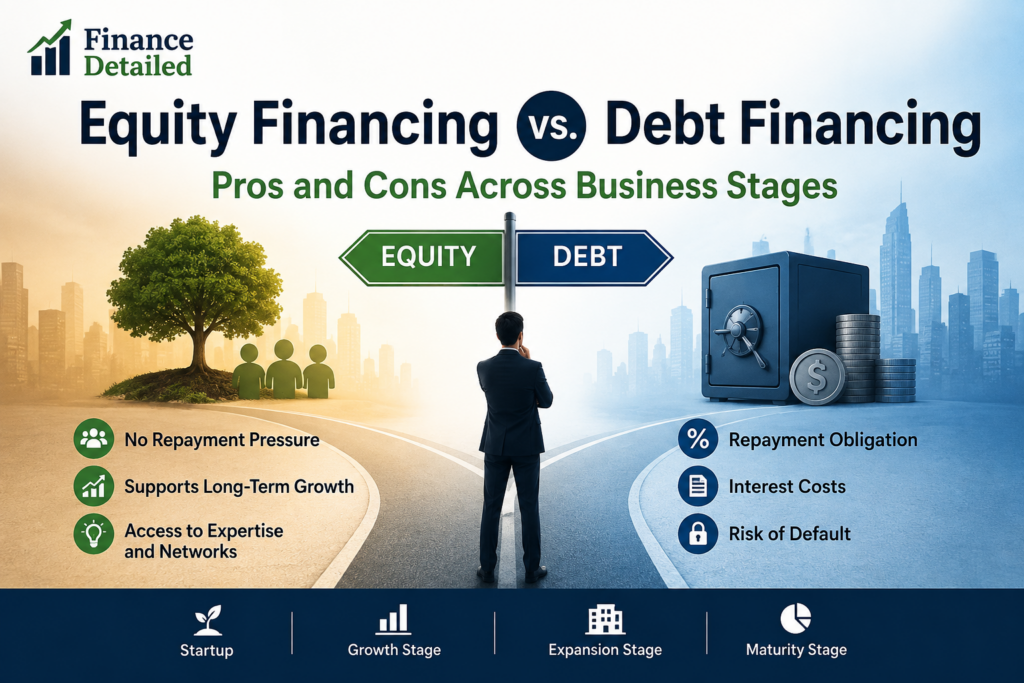
Business growth requires capital, and the decision between equity and debt financing is one of the most significant strategic choices a company will make. Finance experts such as Brealey, Myers, and Allen (Principles of Corporate Finance) emphasize that the right funding mix shapes not only profitability but also long-term resilience. While debt financing involves borrowing money with a fixed repayment schedule, equity financing means selling ownership in exchange for investment. The optimal approach depends on the company’s life cycle, goals, and appetite for risk.
Equity financing exchanges ownership for capital, bringing investors on board who share in the company’s risks and rewards. It often comes from venture capital firms, angel investors, or through a public share offering.
Advantages
Disadvantages
Debt financing provides capital in exchange for interest and principal repayments, but without surrendering ownership. This approach can involve bank loans, bonds, or lines of credit.
Advantages
Disadvantages
| Business Stage | Equity Financing | Debt Financing |
|---|---|---|
| Start-up | Provides capital without revenue history; adds strategic guidance. Risk of control loss through dilution. | Harder to secure without collateral; higher interest rates. Keeps ownership intact if accessible. |
| Small & Medium Enterprise (SME) | Supports scaling; attracts strategic partners. Dilution remains a concern. | Easier to obtain with stable cash flow; tax benefits. Repayment pressure may limit flexibility. |
| Established / Mid-Life | Funds major expansion; may add shareholder expectations. | Strong credit brings favorable terms; retains control. Debt burden can rise in downturns. |
| Mature Business | Useful for restructuring or diversification; potential erosion of legacy control. | Often low-cost debt due to high creditworthiness; risk of over-leverage remains. |
Many companies adopt a hybrid approach, combining equity for strategic expansion with debt for operational needs. The Modigliani–Miller Theorem, when adjusted for real-world considerations like taxes and bankruptcy risk, supports balancing both to reduce the cost of capital. For instance, a profitable SME might use bank loans to finance inventory while securing equity investment for entering a new international market.
When determining the most appropriate route, consider:
The choice between equity and debt financing is not one-size-fits-all. Early-stage businesses often benefit from equity’s flexibility and investor support, while established, cash-positive companies may favor debt to preserve control. Many successful organizations combine both, ensuring stability while fueling growth. Understanding the trade-offs at each business stage enables leaders to build a funding strategy that aligns with both immediate needs and long-term vision.